
Historical Places in Punjab
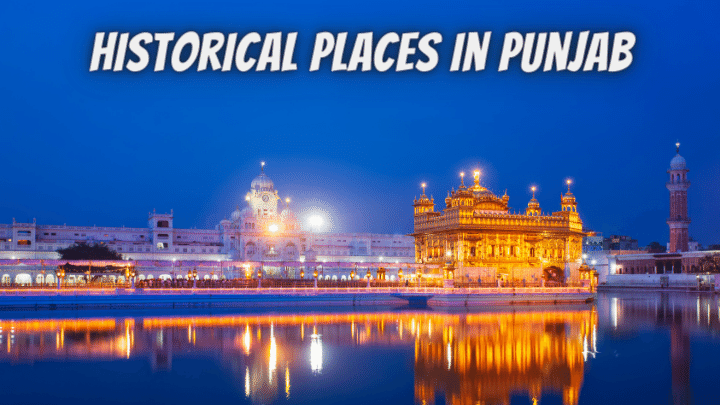
Historical Places in Punjab: Exploring Punjab’s Rich Heritage Historical Places in Punjab: For many centuries in the past, the historic Punjab was overruled by several kings with a heroic past in the nation, which resulted in the creation of stunning monuments, buildings, and lavish palaces. While rural Punjab is famous across the nation because of its lush and green landscapes, paddy fields, agroforestry, and wheat crops, urban Punjab is famous for its ties to Sikh Gurus and courageous rulers. The scientific and historical design of the palaces and forts built across Punjab is highly recognized. Punjab is an absolute must-see destination for anyone who is interested in ancient civilizations, spirituality, or history. Top 10 Historical Places in Punjab 1. Golden Temple The Golden Temple in Amritsar is the first thing that comes to mind when people mention Punjab. This is one of the Sikh community’s greatest cultural treasures, not only a temple or tourist attraction. This is one of the Indian subcontinent’s greatest assets. Its work started in 1577 AD when excavations were made of Amrit Sarovar, also known as Amrit Sarovar, a holy lake. Sri Guru Amar Dass Ji came up with the idea, and Sri Guru Ram Dass Ji took the idea out. Sri Guru Arjan Dev Ji began the building of Sri Harmandir Sahib in 1588 AD. Sri Guru Granth Sahib, the Sikh’s holy book, was first published in the holy temple in the year 1604 AD. The temple’s design communicates a message about living. The temple is constructed in a lower position than the surrounding areas, which is in direct opposition to pride and the ego. Four gates in four directions signify that the location is accessible to everyone. A visit to this temple will surely be an unforgettable experience! 2. Jallianwala Bagh In the period of British rule in India, the 13th of April 1919 is remembered as a day of darkness. The peaceful protests of thousands were brutally massacred by an unnamed British team that was led by General Reginald Dyer, who was suspected of an attempt to overthrow British power since the peaceful protest was organized by Mahatma Gandhi to protest against the Rowlatt Act’s enactment. The bloodbath took place on the Jallianwala Bagh’s grounds, and British soldiers opened fire with no warning. In the history of British administration in India, the 13th of April 1919 is known as being a day of darkness. The peaceful protests of thousands were brutally killed by the British group headed by General Reginald Dyer, who suspected that there was a plot to undermine British authority since the nonviolent protest was organized by Mahatma Gandhi to protest against the implementation of the Rowlatt Act. A memorial was constructed in Jallianwala Bagh following the Declaration of Independence in order to honor the sacrifices made by innocent Indians. Dr. Rajendra Prasad, India’s first president, has dedicated the memorial. Visitors are forever haunted by the images of the chilling incident that was left by shooting marks on the walls. 3. Akal Takht Source: amritsartourism.org.in The Akal Takht, which is the word that means “everlasting seat,” is the high seat that is the seat of Sikh Gurus in the Harmandir Sahib. The seat was constructed in 1606 by Guru Hargovind Sahib. This was known as the Akal Takht, one of the five Sikh thrones, and was a seat of judicial review that allowed the Sikh Gurus to make decisions regarding religious matters. The Akal Takht was built 12 feet high in violation of the decree of Emperor Jehangir, which broke the limit of 3 feet for all thrones with the exception of the Emperor’s. In the course of Operation Blue Star in 1984, it was vandalized. It was finally restored using donations. Read This Also: Low Budget Tourist Places in Tamilnadu 4. Quila Mubarak The stunning Quila Mubarak situated in the middle of Bhatinda evokes images of great rulers from the past like Kanishka, Sultan Mahmud, Razia Sultana, and Prithvi Raj Chauhan. The fort was constructed on Kanishka’s suggestion during the Kushana dynasty. It is also known as Bhatinda Fort. In this fort from the medieval period, Razia Sultana, the first queen to be crowned of Delhi, was imprisoned. This fort is broken into two parts, one of which is called Quila Androon, and the other is known as Quila Mubarak. The royal family was a part of Qila Androon. The building is constructed in an architectural style that blends Rajasthani with Mughal influences. An excursion to the stunning Quila is an experience of wonder and awe. 5. Sheesh Mahal Source: punjabtourism.punjab.gov.in Sheesh Mahal, also known as the “Palace of Mirrors,” is the most stunning of all the visual attractions in Patiala. It was the former residence of Patiala’s kings. Maharaja Narinder Singh conceptualized the palace’s design. The palace is constructed of tinted glass, which adds a splash of color to the castle’s splendor. Rajasthani painters painted murals onto the ceiling and walls that depict ancient stories. The splendor of the building is amplified to a stunning extent by an exquisite garden with fountains, an artificial lake, and a bridge that is known by the name of Lakshman Jhoola. 6. Wagah Border The Wagah Border, which runs through the Grand Trunk Road and is 22 km from Lahore, Pakistan, and 28 km to Amritsar, India, marks the frontier between India and Pakistan. This ceremony, known as the Wagah Border Ceremony, also called the Beating Retreat Ceremony, is the main attraction. It occurs each day. Every evening, around the sunset, Indian and Pakistani soldiers are gathered at this border post to perform a 30-minute show of showmanship and military friendship. The gates to the international border will be shut, and the flags of both nations will be raised during the ceremony. Since 1959, the Indian Border Security Force and Pakistan Rangers have held a flag-raising ceremony. Entertainment is also offered to demonstrate national pride to the thousands of people who visit each day. The crowd is involved in singing an Indian