
Historical Places in Punjab
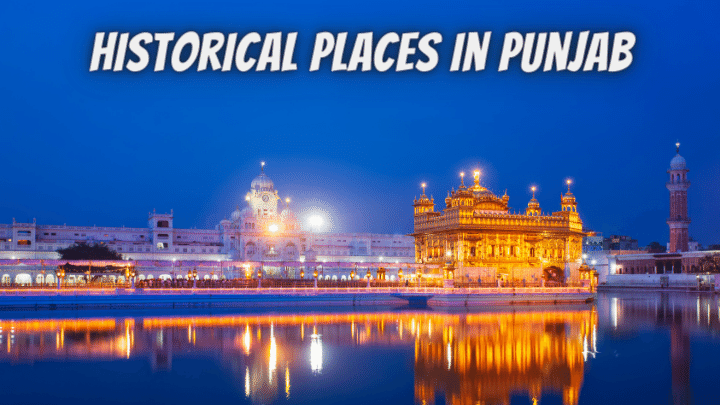
Historical Places in Punjab: Exploring Punjab’s Rich Heritage Historical Places in Punjab: For many centuries in the past, the historic Punjab was overruled by several kings with a heroic past in the nation, which resulted in the creation of stunning monuments, buildings, and lavish palaces. While rural Punjab is famous across the nation because of its lush and green landscapes, paddy fields, agroforestry, and wheat crops, urban Punjab is famous for its ties to Sikh Gurus and courageous rulers. The scientific and historical design of the palaces and forts built across Punjab is highly recognized. Punjab is an absolute must-see destination for anyone who is interested in ancient civilizations, spirituality, or history. Top 10 Historical Places in Punjab 1. Golden Temple The Golden Temple in Amritsar is the first thing that comes to mind when people mention Punjab. This is one of the Sikh community’s greatest cultural treasures, not only a temple or tourist attraction. This is one of the Indian subcontinent’s greatest assets. Its work started in 1577 AD when excavations were made of Amrit Sarovar, also known as Amrit Sarovar, a holy lake. Sri Guru Amar Dass Ji came up with the idea, and Sri Guru Ram Dass Ji took the idea out. Sri Guru Arjan Dev Ji began the building of Sri Harmandir Sahib in 1588 AD. Sri Guru Granth Sahib, the Sikh’s holy book, was first published in the holy temple in the year 1604 AD. The temple’s design communicates a message about living. The temple is constructed in a lower position than the surrounding areas, which is in direct opposition to pride and the ego. Four gates in four directions signify that the location is accessible to everyone. A visit to this temple will surely be an unforgettable experience! 2. Jallianwala Bagh In the period of British rule in India, the 13th of April 1919 is remembered as a day of darkness. The peaceful protests of thousands were brutally massacred by an unnamed British team that was led by General Reginald Dyer, who was suspected of an attempt to overthrow British power since the peaceful protest was organized by Mahatma Gandhi to protest against the Rowlatt Act’s enactment. The bloodbath took place on the Jallianwala Bagh’s grounds, and British soldiers opened fire with no warning. In the history of British administration in India, the 13th of April 1919 is known as being a day of darkness. The peaceful protests of thousands were brutally killed by the British group headed by General Reginald Dyer, who suspected that there was a plot to undermine British authority since the nonviolent protest was organized by Mahatma Gandhi to protest against the implementation of the Rowlatt Act. A memorial was constructed in Jallianwala Bagh following the Declaration of Independence in order to honor the sacrifices made by innocent Indians. Dr. Rajendra Prasad, India’s first president, has dedicated the memorial. Visitors are forever haunted by the images of the chilling incident that was left by shooting marks on the walls. 3. Akal Takht Source: amritsartourism.org.in The Akal Takht, which is the word that means “everlasting seat,” is the high seat that is the seat of Sikh Gurus in the Harmandir Sahib. The seat was constructed in 1606 by Guru Hargovind Sahib. This was known as the Akal Takht, one of the five Sikh thrones, and was a seat of judicial review that allowed the Sikh Gurus to make decisions regarding religious matters. The Akal Takht was built 12 feet high in violation of the decree of Emperor Jehangir, which broke the limit of 3 feet for all thrones with the exception of the Emperor’s. In the course of Operation Blue Star in 1984, it was vandalized. It was finally restored using donations. Read This Also: Low Budget Tourist Places in Tamilnadu 4. Quila Mubarak The stunning Quila Mubarak situated in the middle of Bhatinda evokes images of great rulers from the past like Kanishka, Sultan Mahmud, Razia Sultana, and Prithvi Raj Chauhan. The fort was constructed on Kanishka’s suggestion during the Kushana dynasty. It is also known as Bhatinda Fort. In this fort from the medieval period, Razia Sultana, the first queen to be crowned of Delhi, was imprisoned. This fort is broken into two parts, one of which is called Quila Androon, and the other is known as Quila Mubarak. The royal family was a part of Qila Androon. The building is constructed in an architectural style that blends Rajasthani with Mughal influences. An excursion to the stunning Quila is an experience of wonder and awe. 5. Sheesh Mahal Source: punjabtourism.punjab.gov.in Sheesh Mahal, also known as the “Palace of Mirrors,” is the most stunning of all the visual attractions in Patiala. It was the former residence of Patiala’s kings. Maharaja Narinder Singh conceptualized the palace’s design. The palace is constructed of tinted glass, which adds a splash of color to the castle’s splendor. Rajasthani painters painted murals onto the ceiling and walls that depict ancient stories. The splendor of the building is amplified to a stunning extent by an exquisite garden with fountains, an artificial lake, and a bridge that is known by the name of Lakshman Jhoola. 6. Wagah Border The Wagah Border, which runs through the Grand Trunk Road and is 22 km from Lahore, Pakistan, and 28 km to Amritsar, India, marks the frontier between India and Pakistan. This ceremony, known as the Wagah Border Ceremony, also called the Beating Retreat Ceremony, is the main attraction. It occurs each day. Every evening, around the sunset, Indian and Pakistani soldiers are gathered at this border post to perform a 30-minute show of showmanship and military friendship. The gates to the international border will be shut, and the flags of both nations will be raised during the ceremony. Since 1959, the Indian Border Security Force and Pakistan Rangers have held a flag-raising ceremony. Entertainment is also offered to demonstrate national pride to the thousands of people who visit each day. The crowd is involved in singing an Indian
Historical Places in Assam
Historical Places in Assam | Footprints of the Past Historical Places in Assam: In the northeastern corner of India is situated a land shrouded in history, where the whispers of time echo through the corridors of its ancient monuments. Welcome to Assam, a region rich in culture and heritage, where historical places in Assam stand as living testaments to bygone eras. As we embark on this journey, we’ll unravel the captivating stories woven into the fabric of these historical sites, each one a unique chapter in the annals of Assam’s history. From royal palaces to sacred shrines, join us in exploring the enchanting world of historical places in Assam. Top 10 Historical Places in Assam 1. Hajo Powa Mecca Source: www.thrillophilia.com Hajo Powa Mecca, one of Assam’s most revered monuments, carries with it a spiritual essence reminiscent of Mecca itself. It is the final resting place of Pir Giasuddin Auliya, an Islamic luminary. This sacred site was constructed during the reign of Mughal Emperor Shahjahan and is attributed to the skilled craftsmanship of Mir Lutufullah-i-Shiraji in 1657. It’s believed that the foundation of the mosque here was laid using earth imported from Mecca. Location: 6GRR+P3V, No. 1 Bhelkar, Assam, 781102 2. Rang Ghar, Sibsagar Rang Ghar, often referred to as the ‘Colosseum of the East,’ stands as one of Asia’s oldest amphitheaters and a prominent monument in Assam. Translating to ‘House of Entertainment,’ it was built in 1746 A.D. during the rule of the Ahom dynasty in present-day Assam. This architectural marvel was primarily constructed as a royal pavilion for Ahom kings and nobles to witness events like buffalo fights and other sports at the adjacent Rupahi Pathar. During the Rangauli Bihu festival, it served as a grand royal sports pavilion. Location: Rang Ghar Road, Joysagar, Dicial Dhulia Gaon, Assam, 785697 3. Surya Pahar, Goalpara Source: www.thrillophilia.com Surya Pahar, located 12 kilometers from the Goalpara district, is often referred to as an archaeologist’s gold mine due to its numerous archaeological discoveries. This lesser-known historical site in Assam, known as the “Hill of the Sun” or Surya Pahar, is believed to be associated with the worship of the sun. The artifacts found here are displayed in a local museum, and locals claim that there are 99,999 Shiva Lingas at this historic Assam location. For Buddhists, Hindus, and Jains, Surya Pahar holds historical and religious significance and is designated as one of Assam’s most important ancient heritage sites. Location: 4P55+896, Bhatiapara, Assam, 783101 Timing: 6:00 AM – 6:00 PM 4. Satras, Darang Source: www.thrillophilia.com When you find yourself in Darang, don’t miss the chance to explore the Satras, a glimpse into Assam’s rich and diverse culture. These satras, reminiscent of monasteries, were established by the revered figure Sankardeva and his followers. Aside from their role in performing Bhagawatee Baishnav rituals, these satras serve as custodians of various art forms, including the enchanting Satriya art. Darang is home to two prominent Satras: Khatara Satra, one of the oldest, located 22 kilometers from Mangaldai in Dilipa, and Dihing Satra, situated 45 kilometers from Mangaldai in Kurua. 5. Talatal Ghar, Sibsagar Source: www.thrillophilia.com Talatal Ghar, also known as the Rangpur Palace, stands as an exceptional example of Tai Ahom architecture. Located in northern Assam, it is not only the world’s largest Ahom monument but also a testament to Assamese culture and history. History and architecture enthusiasts should include a visit to Talatal Ghar on their bucket list. The upper ground level, known as Kareng Ghar, showcases classic Mughal architectural style and once served as a royal residence for the Assamese king. The upper levels were added during the reign of Raja Swargdeo Rudra Singha, the successor of Swargdeo Rajeswar Singha. Location: Duboroni Ali Road, Joysagar, Dicial Dhulia Gaon, Assam, 785697 Timing: 8:00 AM – 4:00 PM Read This Also: Flora and Fauna of Assam 6. Khaspur, Silchar Khaspur, a picturesque village in Assam’s Cachar district, lies just 20 kilometers from Silchar. It is one of Assam’s most visited historical sites, known for the ruins of the Dimasa Kingdom. These ruins include a royal temple, a Lion Gate, and a Sun Gate, all steeped in centuries-old history. Although the king’s palace has fallen into disrepair, the grand entrance gates still stand tall. These gates are meticulously designed in the shape of elephants. Khaspur, once part of the Tripura Kingdom, gained autonomy after the decline of the Koch dynasty’s influence. Subsequently, control over Khaspur shifted to the Kachari monarchs, who made it their capital. 7. Charaideo, Sibsagar Source: www.thrillophilia.com Charaideo, a highly sought-after historical destination in Assam, was the capital of the Ahom dynasty, founded by Sukhapa. Located approximately 28 kilometers from Sibsagar, it is often referred to as the ‘Assam Pyramids.’ This site is home to the sacred graves of many Ahom emperors and queens, considered highly holy. On the hilltop of Charaideo, you’ll find around 42 tombs of kings and queens. These tombs bear a striking resemblance to Egyptian pyramids and showcase the exceptional craftsmanship of Assamese artisans during the medieval period. The highlight of this site is the underground vaults, which offer valuable insights into the lifestyles and cultures of the Ahom monarchs. The octagonal dwarf structure that entirely covers each tomb, or maidam, is a distinctive architectural feature. The intricate floral designs adorning the underground chambers are truly captivating, with the chambers themselves concealed beneath clay mounds. 8. Sukapha Samannay Kshetra, Jorhat Source: www.justdial.com Sukapha Samannay Kshetra is a significant historical site dedicated to Sukapha, the first Ahom ruler of Assam. Situated between Mohbandha, near Jorhat, and Dergaon, this site commemorates Sukapha’s influential leadership. Sukapha, a Thai royal, journeyed to this region after crossing the Patkai mountain range, uniting tribal and non-tribal communities. The Sukapha Samannay Kshetra stands as a tribute to his illustrious legacy. Location: Mohbondha Road, Jorhat, Assam 785006 Timing: 10:00 AM – 4:00 PM 9. Ladai Garh, Jorhat Source: www.tripinvites.com Ladai Garh, a fortified structure located approximately 13 kilometers from Jorhat, is a must-visit historical site. It stands as